
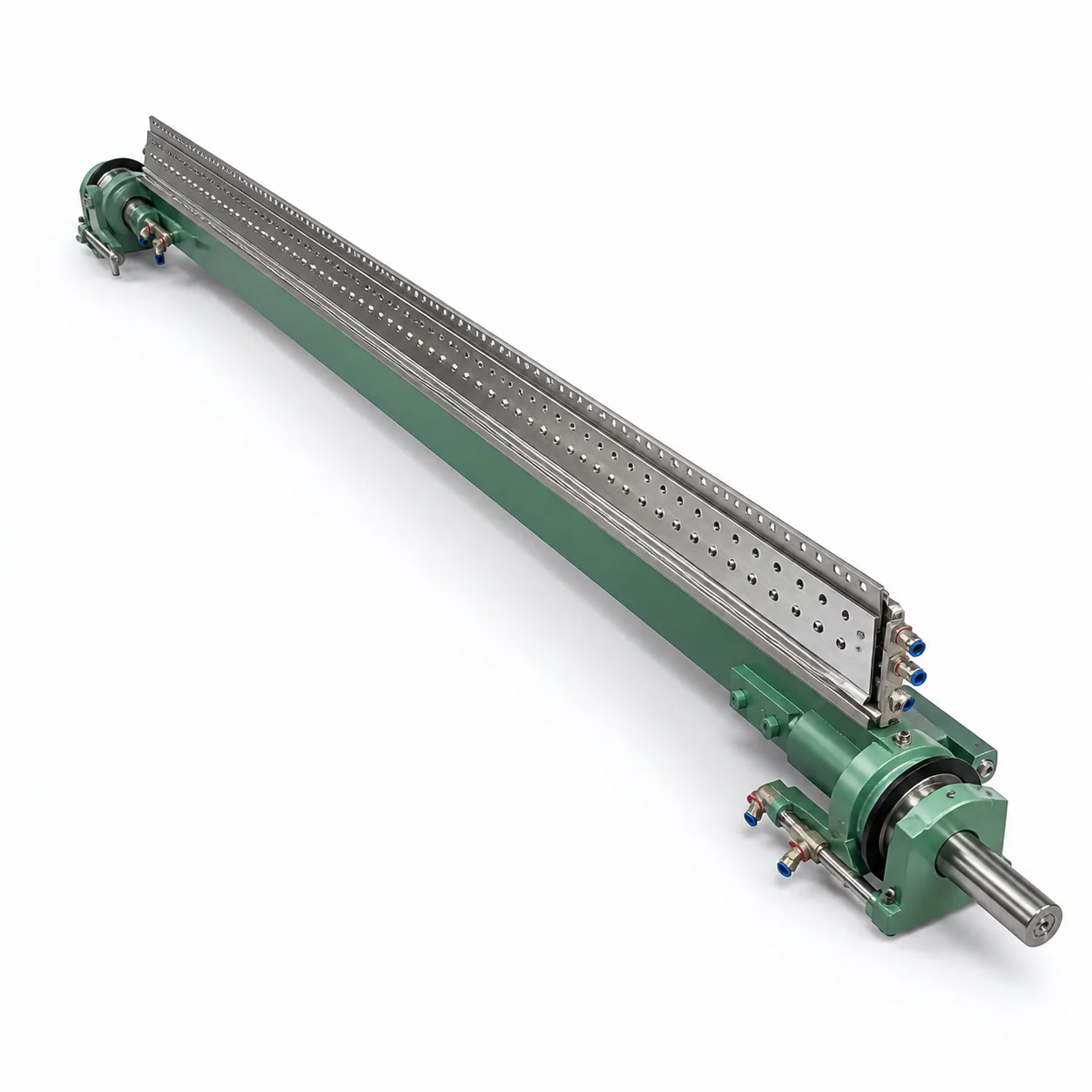
A doctor blade system must match its roll, duty and operating environment. Selecting only by blade width or material can lead to poor cleaning, uneven loading, chatter, accelerated wear or unsafe service. A reliable specification begins with the exact machine position and the problem the doctor is expected to solve.
1. Define the duty and machine position
Identify the roll name, roll surface, machine section and primary duty. Cleaning, sheet removal, creping and water management are different applications. Record normal speed, temperature, moisture, chemical exposure and the material that accumulates on the roll.
For a rebuild, describe the current problem with photos and operating observations. Note whether contamination is uniform, concentrated at the edges or linked to grade changes. This helps separate blade-system issues from roll, shower, alignment or process causes.
2. Match the blade to the surface and contaminant
Blade material, thickness, bevel and contact angle should be evaluated together. The choice depends on roll cover, temperature, chemical conditions, speed and the required balance between cleaning and wear. A more aggressive blade is not automatically better; it may shorten roll-cover life or create instability.
Confirm the supplier’s recommendation for start-up, inspection and replacement. If several grades or chemicals are used, include the full operating range rather than only the most common condition.
- Roll surface or cover material
- Contaminant and cleaning objective
- Blade material, thickness and edge profile
- Contact angle and recommended loading range
3. Select a holder that loads evenly
The holder must maintain consistent contact across the machine width while accommodating practical blade changes and cleaning. Pneumatic loading can provide controllable pressure, but the beam, holder, air system and mounting geometry still need to work as a complete assembly.
Ask how the holder releases, how the blade is retained and how operators access the position. Guarding, lockout, sharp-edge handling and safe blade replacement are part of the application review, not afterthoughts.
4. Review beam rigidity, alignment and oscillation
A long doctor beam needs adequate rigidity and suitable supports. Confirm mounting points, available space and thermal conditions. Misalignment or beam deflection can create an uneven contact line even when loading pressure appears correct.
Oscillation may help distribute wear and reduce localized buildup in suitable applications. If required, define stroke, frequency, drive type, available utilities and space. Oscillation should be integrated with the holder and surrounding equipment rather than added without an interface review.
5. Plan showers, drainage and maintenance access
A doctor works within a surrounding cleaning system. Review showers, save-all arrangements, drainage and splash control. Accumulated material must be removed from the area safely; otherwise the blade may simply transfer the problem elsewhere.
Maintenance access should allow inspection across the full width. Include blade storage, handling tools and initial spare quantities in the supply discussion. A documented inspection routine helps identify uneven wear before it affects the roll or sheet.
Doctor system RFQ checklist
Provide dimensional and operating information with clear photos or drawings. For a replacement, include details of the existing doctor and mounting points.
- Machine section and roll function
- Roll diameter, face length and surface material
- Machine speed and temperature
- Contaminant, chemicals and moisture
- Available air pressure and electrical standard
- Mounting drawing, site photos and access limits
- Required blade, holder, beam, oscillator and control scope
FREQUENTLY ASKED QUESTIONS
Questions buyers often ask
What data is needed to size a doctor blade system?
Provide the machine position, roll diameter and face length, surface material, speed, temperature, contaminant, mounting details, available utilities and required scope.
Does higher blade loading improve cleaning?
Not necessarily. Excess loading can increase wear, heat and instability. Loading should be matched to the blade, holder, roll surface and duty.
When should a doctor use oscillation?
Oscillation can help distribute wear or buildup in suitable positions, but stroke, frequency, space and integration must be reviewed for the specific application.